

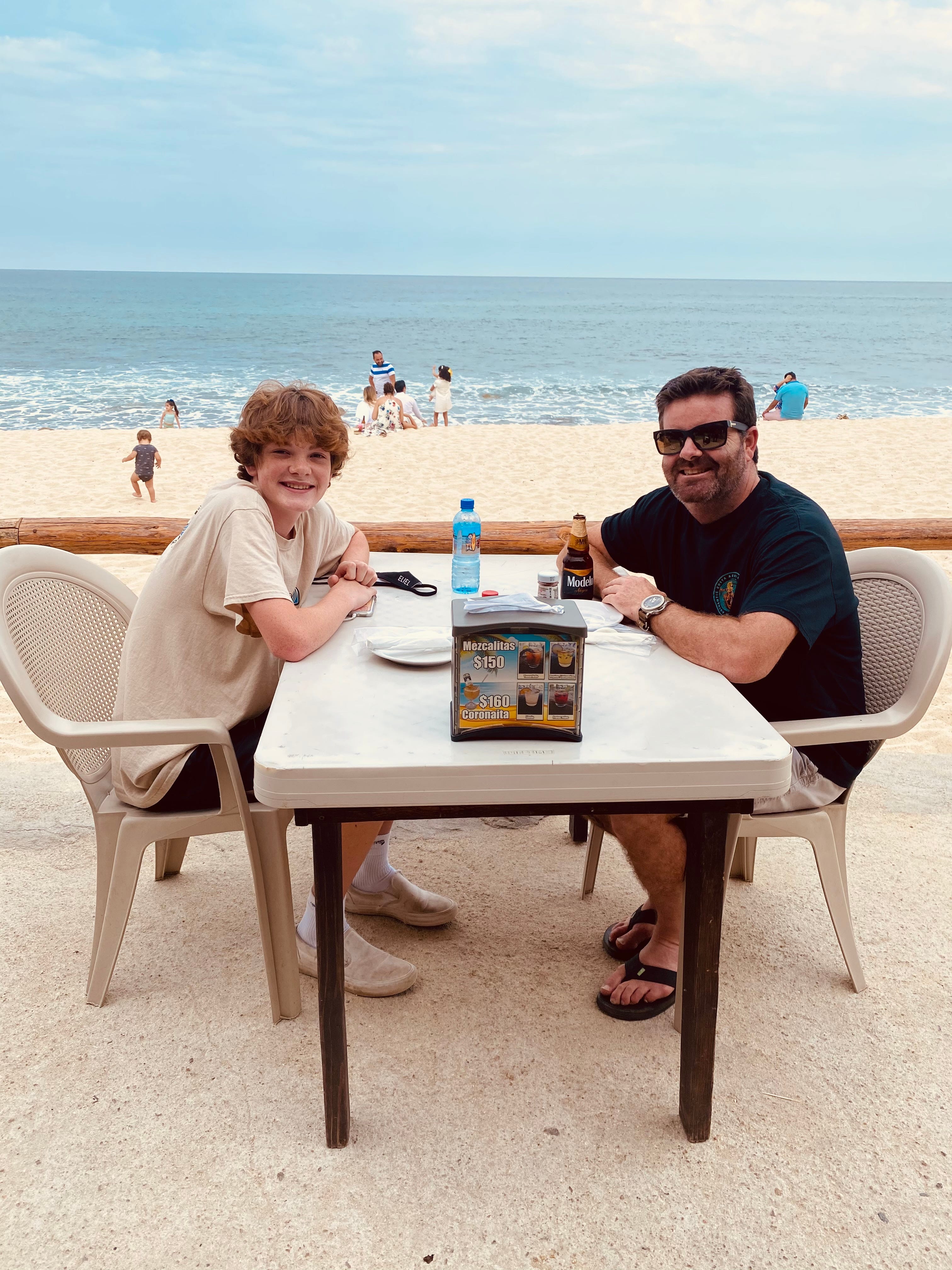
(Photo: Cabo San Lucas with my youngest for our annual father-son trip. This time surfing.)
How many of us can still hear our parents in our heads throughout our daily lives? I hope you read this and it helps you think about the kind of voice you want to be for your child.
Enjoy the read,
Brandon
PUDDLE JUMPERS EXCERPT
“The everyday inputs we give our kids, our words, our tone, our expectations, matter more than most people realize.”
There is a quiet voice in the back of every person’s mind. It narrates. It comments. It decides, before you have even tried something, whether you are the kind of person who can do it. And here is the part that should stop every parent cold: that voice did not come from nowhere. It was installed. Usually early. Usually by an adult who did not know the weight of what they were saying.
Your voice becomes your children’s inner voice. The way you talk to your kids today is the way they will talk to themselves for the rest of their lives. That is not a poetic exaggeration. It is how the developing brain works. And once you understand it, you cannot unsee it.
You see it everywhere once you start paying attention. People casually beating themselves down without even realizing it. “I’m not good with numbers.” “I’m just not athletic.” “I’m a klutz.” “I could never do that.” It is like we are all carrying around this quiet negative loop in the back of our minds, repeating old stories someone else planted there years ago. Maybe it was a teacher, a coach, or a parent who did not know any better. But over time, that kind of talk becomes automatic. People start believing their own limitations as if they are facts instead of habits.
It shows up in the smallest ways in kids. Shrugging off new challenges. Backing away from opportunity. Quitting before they even start. And unless you catch it and flip the script, it becomes a self-fulfilling prophecy.
The five to one rule
A study by the Gottman Institute at the University of Washington found that for every one negative interaction, a child needs at least five positive ones to maintain emotional stability. Sit with that for a second. Every time you or another adult barks at your kid or shoots down their idea, it takes five moments of genuine connection just to get them back to neutral. Stack enough negatives, and you are not building resilience. You are breaking trust.
Negative input wears them down like water running over stones. Positive, constructive input builds them up like forging steel. If all they hear is where they are falling short, they start believing they are not capable. But when they get consistent, honest encouragement alongside the correction, that is when they step into their full potential.
This is not about empty praise or telling your kid they are perfect. It is about being deliberate with the words that are quietly building the voice they will carry forever.
The goal is to teach them to become their own coach. When they hear something negative, whether it comes from the outside world or from that loop in their own head, they can learn to pause, take a breath, and say, “That’s one opinion, not the final word.” Then reframe it with their own positive take. That is how they get stronger, both mentally and physically.

(Photo: Yes, I can surf!)
EVERYDAY REFRAMES FOR RAISING MENTALLY TOUGH KIDS
Instead of: “That’s just not who you are.”
Say: “You get to decide who you are, one choice at a time.”
Instead of: “You failed.”
Say: “You found one way that didn’t work. That’s progress.”
Instead of: “Don’t embarrass yourself.”
Say: “The only real loss is not showing up.”
The proof, in my own house
This is not theory I read in a book. It is the same mental management system I taught to Navy SEAL snipers, and I used it on my own kids.
There was a time my oldest son, Jackson, had to get up in front of his elementary school class to give a talk, and he was terrified. He is not alone. About 77 percent of people have at least some fear of public speaking. I showed Jackson how to visualize the experience over and over in his head to get rid of his nerves, to rehearse success until his brain treated it as familiar. Years later, he was recognized as an Academic All-American for his high school speech and debate accomplishments.
I remember the first time my daughter used the same technique before a downhill ski race in Oregon when she was on the high school team. “This stuff really works, Dad!” she beamed after putting up the fastest time.
Guiding your kids through this kind of mental rehearsal, and being deliberate about the voice you are building in them, is a powerful skill they will carry for the rest of their lives. It costs nothing. It requires no special training. It just requires you to understand that every word you say to your child is being recorded and will play back, in their own voice, long after you have forgotten you said it.
Choose those words like they matter.
Because they matter more than almost anything else you will ever do.
You can order Puddle Jumpers here.
Thx,
Brandon
The reframe list is solid, especially the failure one. Though I will say, getting kids to actually *say* those reframes out loud when they're mid-tantrum is a whole separate Olympic sport!
Great message - I absolutely agree!