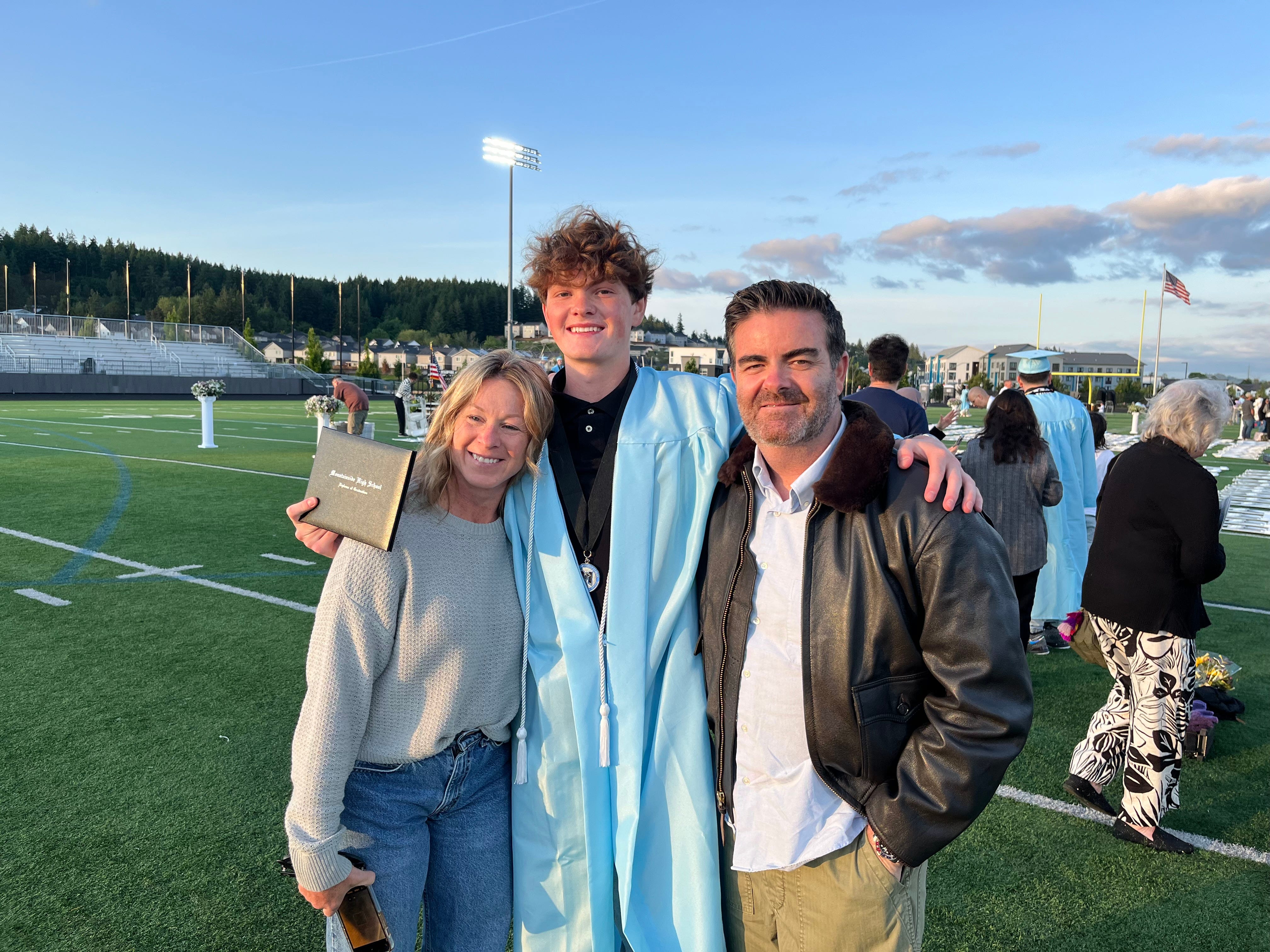
(Photo: Gretchen and I with our youngest son at his high school graduation in Oregon. Yes, he’s tall! 6’ 3” and still growing!)
Over twenty years ago, Gretchen and I stood in front of a television and watched the second tower fall. I turned to her and said, “I have to go.”
We were married then. We are not now. But we raised three kids together through deployments, distance, a divorce, and plenty of hard times, both emotionally and financially. And somewhere in all of it we built something that outlasted the marriage: a real partnership as parents.
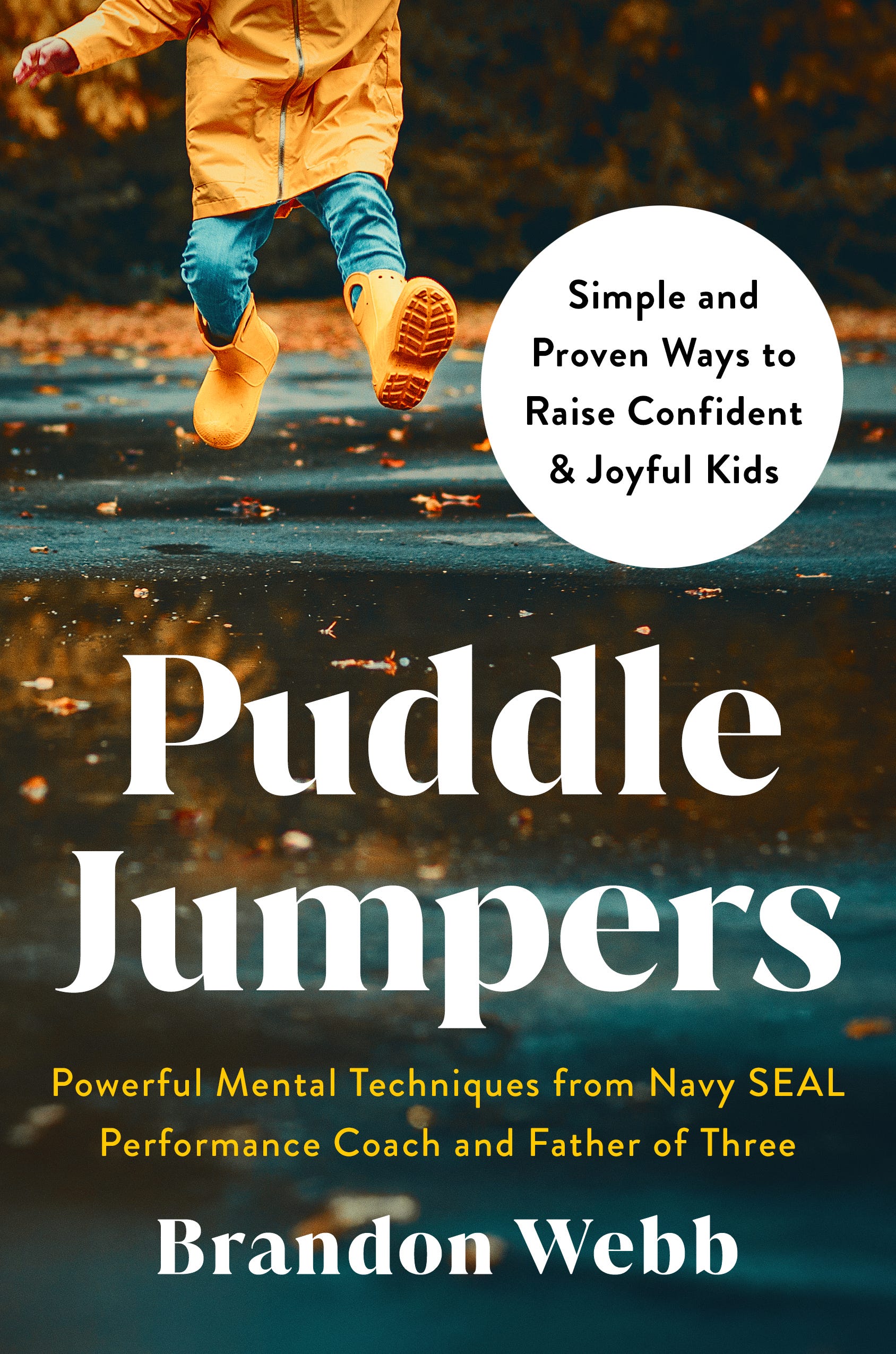
So when I finished writing Puddle Jumpers, there was only one person I wanted to write the foreword.
Foreword
As we stood there watching the second tower fall on TV, Brandon
looked at me and said, “I have to go.”
I was shocked, yet I knew in my heart exactly what he meant.
This was what he, and all of the SEAL Teams, had been training for.
Not even twenty- four hours later, we had named our soon- to- be-born
son, and Brandon was off to war. I was seven months pregnant
with our first child, unsure of when I would ever see my husband
again.
Life tends to test you in ways you could never imagine— tests
that push you to your breaking point but also free you when you
rise stronger from them. Parenting— and co- parenting— tests you in
similar ways. It takes patience, communication, and above all, respect.
Brandon and I have a deep appreciation for each other as co- parents.
This book comes from a place of wanting to help other parents
be their best, no matter their circumstances. It’s honest, practical,
and rooted in lived experience, not theory. If you are a parent,
I hope you take what you find here to heart. And if you are a
divorced co- parent, I hope it reminds you how vital it is to lift each
other up along this lifelong journey we call parenting.
-Gretchen Maybee
Introduction
We’d just come off the mountain after a great, long day on the
slopes, legs smoked, everyone ready to chill out. While slogging
through the parking lot back to my car, gear dangling off every
limb, the youngest of my three kids, Tyler, spots it: a half-frozen
puddle of slush and mud, so gnarly it looked as if it had its own
ecosystem. I can still picture his face lighting up as he started run-
ning straight for it with the delight of a dog chasing a tennis ball.
Tired, cold, and looking forward to getting home in front of the
fireplace, my default parent mode kicked in, ready to shut it down.
I opened my mouth to snap, “Don’t even think about it, T-Man!”
But I suddenly stopped myself.
Why? Because in that split second, I realized something. By
stopping him, I wasn’t protecting him. I wasn’t helping him. I wasn’t
really looking out for him at all. I was projecting my own adult
hang- ups— the inevitable mess, the inconvenience of a drenched
six- year- old on the drive home, the extra laundry, him looking
ridiculous. Instead, I had to ask myself an important question all
parents must ask themselves at times: Why the hell not?
So as he looked over his shoulder, I took a deep breath, smiled,
and said, “Get after it, dude!” He launched in full send mode.
Whooouush! Muddy ice slush all over his clothes and face, laugh-
ing like the little maniac he still is today. And that’s when it hit me:
These are the kind of kids I want to raise. Those who jump into
life, not around it. I want to raise puddle jumpers, kids who aren’t
afraid to get dirty in pursuit of a joyful life.
As parents, we’ve got to check ourselves. Too often, we’re shutting
down our kids, not just out of our unfounded concerns or personal
bias, but because we’re dragging around our own baggage: fear of
judgment, need for control, leftover perfectionism from childhood.
That day, I almost stomped out my kid’s curiosity. But I caught
myself. I let him jump into the mud, and boy am I glad I did,
because this wasn’t just about letting a kid be a kid— it was about
clearing the runway to land. I’ve had some incredible jobs in my life,
from Navy SEAL to entrepreneur, but being a dad tops them all.
It’s the one role that humbles you, teaches you, and pays you back
in moments like this— muddy boots, wide smiles, and a reminder
that you’re the luckiest guy on earth.
Clearing the Runway
At twenty- eight, I became the head instructor of the US Navy
SEAL sniper course. But over the next few years, even as I achieved
the peak of my SEAL career, teaching the next generation of elite
snipers, I started to feel the cost of that life. My marriage was on
the rocks, and I could see the distance growing between me and my
kids. After living on adrenaline during thirteen years of go- go- go
deployments, followed by demanding ninety- hour work weeks as a
sniper instructor, I had to face a hard truth: If I wanted any kind of
future with my children, I needed to make a change. So I made the
most difficult call of my life— I left the T eams. I chose my family
over the Navy, knowing that no mission, no matter how critical,
was more important than being there for my kids.
What I never expected was that the same mental management
techniques I’d learned and used to teach deadly SEAL snipers would
also apply to my transition to civilian life, along with all the land
mines I’d encounter on the way: the loss of my first business, my
entire life savings destroyed, divorce, and all the time spent trying
to be a good father to my three children.
The core principles of being a great sniper align with those of
any effective mental management program for performance, such
as with sports: visualization (or mental rehearsal), a positive outlook
in all situations, self- image management, and positive verbal cues.
(The big difference, of course, is that missing a shot in, say, basket-
ball is not a life- or- death situation.) As a dad, I’ve used these prin-
ciples, along with my background as a former helicopter crewman
and later pilot, to develop my own style of parenting. This proved
to be an incredible tool and parenting hack for me as a divorced
father of three.
My children are all different in their own ways. The oldest,
Jackson, has always been interested in computers, math, debate club,
music, and chess. He’s more calculated and thoughtful in his deci-
sions. Madison is in the middle, the creative one of the family and
brave in everything she does. Tyler is the youngest; he’s also great
at math, though not very interested in academics, and sportier than
his siblings. Like his dad, he wants to act without overthinking and
contemplating every detail.
We are not a perfect family, and I’m not a perfect father. I’ve
made plenty of mistakes, but regardless of my missteps, I can say
I’ve been consistent with my love and support. And though we’ve
been through a lot of tough times as a family, we’ve come out the
other side better for it.
I deployed to Afghanistan right after the September 11, 2001,
terrorist attacks as a Navy SEAL with Team 3 ECHO platoon. My
wife at the time, Gretchen, was seven months pregnant with Jack-
son, and everything felt clouded in uncertainty. I later went to Iraq
as a defense contractor, which was no cakewalk either. After losing
my first start- up in 2008, my wife and I divorced, and a cascade of
events followed: moving cities, and schools, multiple times; leav-
ing friends behind; losing people my children were close to at a
young age, particularly my friends in the SEALs; dealing with issues
around drugs and alcohol; and handling the other typical challenges
we all contend with as parents. Of course, those challenges are
growing: On top of death, drugs, alcohol, sex, and family drama,
we now have social media, the internet, and artificial intelligence
changing the fabric of our society, not to mention our existence.
We’ve also entered a new era as parents. All of the tightrope-walking,
shark- dodging, and dream- protecting we do for our kids
often takes place without the village our grandparents took for
granted. According to Pew Research, fewer than 30 percent of US
parents live near most or all of their extended family, and many
report feeling isolated in their parenting role. Further, academic
findings show that modern parenting support is becoming increas-
ingly individualized, meaning fewer hands in the fight, less shared
wisdom, and more solo struggle.
The extended family used to live down the street— now they’re
a time zone away on FaceTime. Neighborhoods once raised kids
shoulder- to- shoulder; now, most of us are winging it behind closed
doors in big cities or isolated suburbs, searching for answers on the
internet at midnight and hoping we don’t screw up the one job
that matters more than any other. That gap, the space where wise
uncles, tough aunties, and watchful neighbors used to stand, needs
to be filled.
There is little in the way of practical tools and advice (from
actual parents, not academia) on how to raise kids in today’s crazy
world. Like most, I didn’t take any parenting classes; I just started
winging it. But I had an unfair advantage: my SEAL sniper training.
No Greater Mission
I’m not here to hand you an encyclopedic manual of parenthood.
Hell, nobody could do that. What I am doing is laying down the
parts that count, the lessons that left scars and the ones that saved my
ass: a guide to parenting with intention, so you’re not just reacting
to fears, but shaping your child’s future with purpose. This isn’t the-
ory; it’s blood, sweat, and the kind of trial by fire that only raising
kids can deliver. I’m filling the foxhole with every lesson I learned
the hard way: self- taught, parent- tested, and refined through raising
my own three kids with my co- parent and ex.
My hope is simple: that somewhere in these pages you find a
tool, a phrase, or a mindset you can carry into your own battles at
home. From one parent to another, I’m giving you what I’ve learned
in the arena, because while we can’t cover everything, we can damn
sure focus on what matters most.
In recent years, as my kids grew into young adults and started col-
lege, I found myself being asked for parenting advice. The questions
came from my circle of friends, new parents, and peers from business
school and alumni communities, often after they’d spent time with
my kids and walked away genuinely impressed by how they carried
themselves. I’d even get asked for advice at conferences where I was
the keynote. People were curious— especially when I told them my
parenting system was based on techniques I developed as a Navy
SEAL— and would always dig deeper, asking more questions.
So I finally decided to write this book and share my experience
as a father. I’m not a parenting academic. Through most of my kids’
early lives, I was a divorced dad. But as my kids developed into
capable young adults, it became clear that their mom and I had done
something right. I felt like I had something to offer other parents
on their journey, sharing my own messy parenting experience and
all the lessons I’ve learned along the way.
There’s no greater mission as a parent than raising a child who
knows who they are and has the tools to thrive and become the cap-
tain of their own life. It’s an amazing feeling when your kids grow up
and blossom into happy adults, and you realize they are truly prepared
to handle the world on their terms. And that’s the real goal: You must
prepare your children for the world, not protect them from it.
I still remember my daughter Madison visiting me in 2024 dur-
ing her summer break from Goldsmiths, University of London,
where she was a design student. Over dinner at my favorite French
restaurant, Grenache, in Lisbon, she told me, “Dad, I just want you
to know I am exactly where I want to be in my life, and I appreciate
you allowing me to be myself.”
What an amazing thing to hear as a parent.
It’s these moments that powerfully reveal the return on our
investment for all those years of being a consistent parent who
shows up every day.
By guiding our children to become happy adults, we’re not just
shaping their future either— we’re contributing to a stronger, more
compassionate humanity. I think we can all agree that, considering
the state of the world, this is a good thing.
What I’m going to teach you forever changed my life for the
better. The principles in this book have helped me greatly, and if you
commit to them, they will remain with you for years to come. You’ll
be a better parent, grandparent, spouse or partner, and person for it.
If you’re thinking, “My kids are too old, and I’ve missed the
boat!” I want to stress that “No, you haven’t.” It’s never too late to
learn these lessons in mental management. I didn’t learn them until
I was close to thirty years old. These techniques have also helped
me deal with my own father-son dynamic with my dad, Grandpa
Jack to my kids.
Having kids is not easy, especially in the ultraconnected world we
live in today, where negativity is just a click away, but there’s hope!
At the core of this book, my primary mission is to equip you
for the rewarding yet demanding journey of parenthood. I want to
help you raise kids who are not just happy by their definition but
also kind, curious, and independent doers. Or as I like to describe
them, puddle jumpers.
The Only Easy Day Was Yesterday
Just as I’m not a perfect father, nobody is a perfect parent; we all
struggle with the hands life deals us. However, the imperfections,
mistakes, and stressors, when handled correctly as parents, make our
children blossom into beautiful adults. In most cases, it’s all neces-
sary. We went through hell as a family, and my kids still turned out
to be joyful, bold, and resilient.
In the SEAL Teams, we have many sayings, but the one that
most applies to being a parent is the same creed I still live by: “The
only easy day was yesterday.” As parents, we must bring our best
effort every day, even on our bad days, which we all have. I’ve seen
too many SEALs get comfortable, even cocky, and then get sent
back to the regular Navy for not bringing their all to the job daily.
Yesterday’s challenges are gone, in the rearview, and there’s no use
focusing on the past, only the present and what’s coming.
Parenting is one of the most rewarding jobs. If done right, it is
about being consistent, and consistency is the enemy of part- time.
It’s up to you what kind of parent you want to be: a part- time par-
ent or a full- time parent who is a constant force in your child’s life.
Your kids will remember your parenting legacy forever, and how
they turn out, good or bad, is largely up to how you parent.
Every chapter here outlines a clear theme and ends with a fam-
ily challenge and an actionable parenting checklist. These ensure
that you’ll always have a battle plan for handling life’s toughest
moments as a family. There’s also a whole section of parenting
resources in the back of the book, full of reminders, tips, and sug-
gestions to help you throughout your journey. With these tools,
you won’t just raise kids who can weather the storm; you’ll raise
self-reliant
leaders, capable of charting their course and thriving
in a world full of challenges. If you are consistent in using the fol-
lowing methods, you’ll end up with incredible children who are
independent, happy, and living a life filled with purpose.
And what parent wouldn’t want that for their kids?
Thx for listening. -Brandon
*Please order the book here, and I appreciate you sharing this with a parent who could use some practical advice on how to raise kids in this crazy world. You can order Puddle Jumpers here.